
Entrepreneurial Education Market Poised for Strong Growth
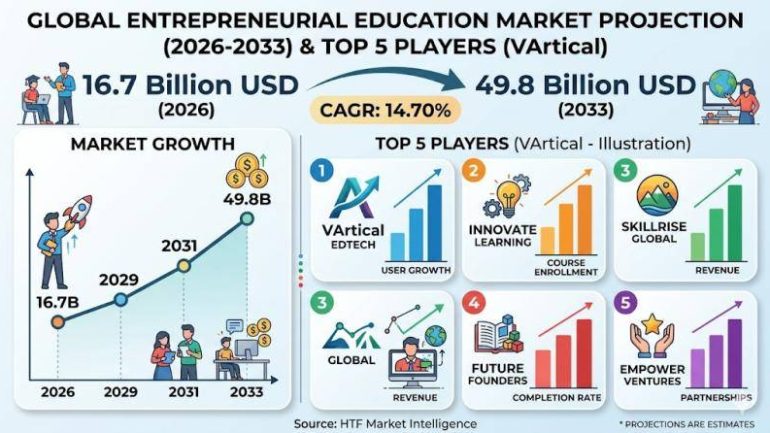

The global entrepreneurial education sector is experiencing sustained expansion, driven by rising demand for innovation skills, startup development training, and digital learning platforms. According to recent market analyses, the sector is expected to grow at a steady double-digit rate, reflecting increasing institutional and corporate investment in entrepreneurship-focused learning systems.
At its core, entrepreneurial education focuses on building the skills, mindset, and practical knowledge needed to launch and manage ventures. This includes training in business planning, financial literacy, marketing strategy, leadership development, and innovation management. Programs are delivered through universities, online platforms, incubators, bootcamps, and corporate training environments.
A major driver of growth is the global rise in startup ecosystems and government-backed entrepreneurship initiatives. As more countries encourage small business creation and innovation-led economies, demand for structured training programs continues to expand. Digital transformation is also reshaping delivery models, with online courses and AI-supported mentoring systems making entrepreneurship education more accessible and scalable.
Market studies highlight that entrepreneurial education is increasingly integrated into broader digital education ecosystems, including edtech platforms, hybrid learning environments, and corporate upskilling programs. These systems allow learners—from students to working professionals—to engage with entrepreneurship training in flexible and personalized ways.
Industry reports also emphasize emerging trends such as incubator-based learning, experiential education models, and AI-driven advisory tools that simulate real-world business decision-making. These innovations are improving engagement and helping learners transition more effectively from theory to practice.
Despite strong growth, challenges remain. Limited access to mentorship, inconsistent program quality, and high training costs can restrict participation in some regions. However, increasing collaboration between universities, startups, and industry partners is helping to address these gaps.
Looking ahead, the entrepreneurial education market is expected to continue expanding as digital learning tools, global startup activity, and demand for practical business skills converge. This positions the sector as a key pillar in the future of education and workforce development.