
Insper & AACSB Discuss Business Education Standards Future

- Posted by cbsmodir
- Posted in Education, International, Latest, Learning
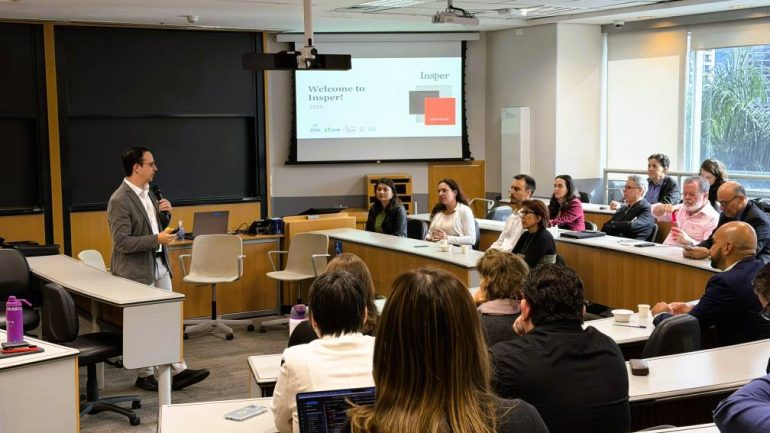
Insper and the AACSB recently hosted a high-level discussion on the future of business education accreditation and the evolving role of applied research in universities.
The event, titled “Driving Excellence in Business Education: Insights from AACSB & Insper,” brought together academic leaders and accreditation specialists to reflect on how business schools can better demonstrate the real-world impact of their teaching and research. The conversation also explored how new accreditation standards may reshape global expectations for academic institutions.
AACSB representatives highlighted the organization’s global reach and tools that support member schools, including digital platforms for faculty collaboration and large-scale institutional data systems designed to inform decision-making. Established in 1916, AACSB now connects thousands of institutions worldwide and continues to refine its accreditation framework to emphasize measurable impact.
A central theme of the event was AACSB’s new standards, which are structured around three key dimensions: teaching impact, research relevance, and societal contribution. These include expectations that faculty demonstrate individual teaching effectiveness, that research connects meaningfully to practice, and that institutions actively engage with societal challenges.
Insper’s leadership emphasized its commitment to applied knowledge and international engagement. The institution—holding AACSB, AMBA, and EQUIS accreditation—has participated as a pilot school for the upcoming 2027 review cycle under the new standards. According to its leadership, this aligns with its mission: “More important than the seal itself is taking advantage of AACSB’s global network of best practices.”
A panel discussion on research impact further examined how universities can ensure academic work extends beyond journals. Speakers argued that rigorous research should not be isolated from real-world problems. One participant noted that academia contributes most effectively when it maintains independence, methodological rigor, and openness to unexpected findings: “impartiality is extremely important and is what distinguishes academic work from other types of work.”
However, the discussion also highlighted challenges, particularly the cultural gap between academia and industry. Trust, rather than infrastructure, was identified as a key barrier to collaboration. Participants suggested that stronger partnerships and shared research design processes could improve the relevance and uptake of academic work.
The event concluded with agreement that the future of business education will depend on balancing rigor with relevance, while developing more sophisticated ways to measure the societal impact of research. This shift reflects a broader transformation in global higher education toward accountability, collaboration, and measurable outcomes.